
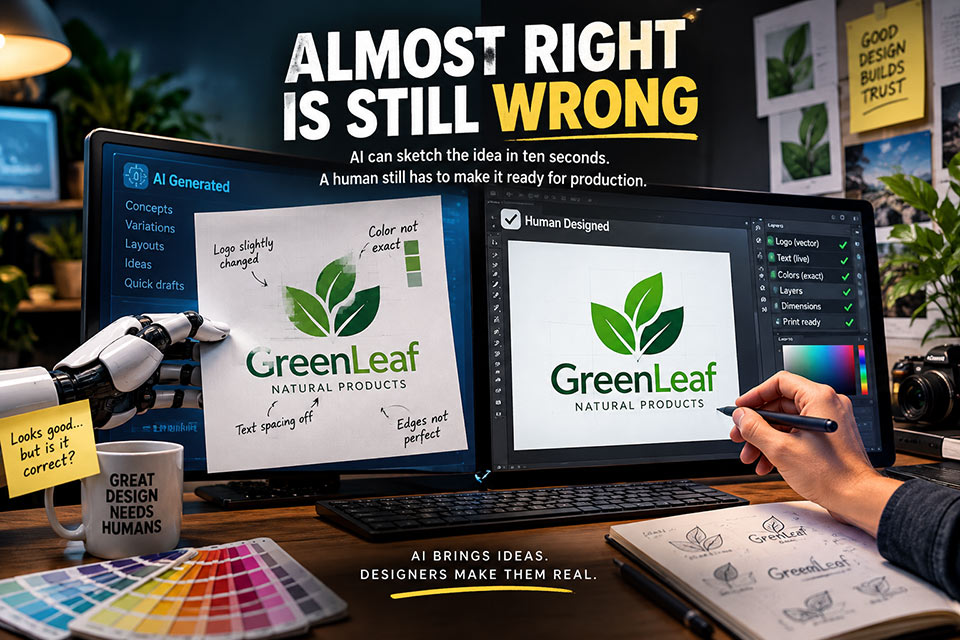
AI can sketch the idea in ten seconds. A human still has to make it ready for production.
Scroll any feed and you’ll meet the same promise: one prompt, one brand. One prompt, one app. Fire the team. Meanwhile, in real studios and real codebases, someone is zooming in to 800% to repair a logo the machine “improved” without being asked, or reading forty lines of confident code that does almost, but not quite, what was needed.
AI in design and development is not a myth. It is a remarkable tool. But there is a canyon between generating something impressive and producing something you can print, ship and defend, and the advertising rarely mentions it. This article is about that canyon.
Why the hexagon never quite closes
Professional design software holds objects. A logo is a vector file. Text is a live layer you can edit. A color is a specific value, a hexagon is pure geometry, and a dimension is a number. Nothing moves unless you move it.
Most AI image generators work differently. They don’t assemble a design from protected parts; they paint pixels based on patterns learned from millions of images. Ask for a hexagon and you get something that looks like one, built by prediction rather than math. Ask for a precise red and you get a red in the neighborhood. Hand over your logo and say “keep this exactly,” and the model may quietly redraw it: a letter slightly wider, a curve slightly off, a shade slightly different.
That is why designers keep spotting the same telltale traces: uneven edges, drifting colors, warped lettering, decorative details nobody asked for. None of this means the output is ugly. It means the output looks correct without being correct, and in branding, that gap is the whole game.
Even Adobe is saying it out loud
Notice what the biggest name in design software is investing in. Illustrator’s generative tools produce editable vector shapes rather than flat pictures, and a feature called Retype converts static text inside an image back into live, editable text. Adobe’s own pitch is that AI helps designers explore directions in seconds, which they then refine by reshaping, recoloring and restructuring.
Read that again. The industry leader isn’t promising that AI replaces the finishing. It is building tools to make AI output editable by humans, because a picture nobody can fix is not a deliverable.
The ad that took five weeks
In December 2025, McDonald’s Netherlands released a 45-second, fully AI-generated Christmas ad and pulled it within days after viewers called it creepy. The company described the episode as an important learning. Reporting on the production put numbers on the “magic”: ten people, working full-time for five weeks, with hours that exceeded a traditional shoot.
Coca-Cola had faced similar backlash over its 2024 AI holiday ad. Its 2025 follow-up arrived with a documentary about the humans involved in making it. Even the believers understand the secret: behind a “made by AI” ad there is often a team doing the selecting, editing and fixing. The machine produces material. People supply taste, and audiences can tell when taste is missing.
Developers: same movie, different screen
Developers have their own version of the hexagon problem, and it comes with better data.
In 2025, the research nonprofit METR ran a randomized trial with 16 experienced open-source developers working on 246 real tasks in codebases they knew well. Beforehand, they predicted AI tools would make them 24% faster. In reality, tasks took 19% longer with AI. Afterwards, they still believed they had been about 20% faster. The time went into prompting, waiting and reviewing instead of writing.
Be fair to the caveats: the sample was small, the developers were veterans on familiar projects, and the early-2025 tools have improved since. The authors did not claim AI is useless, and many participants kept using it. But the lesson survives: feeling fast and being fast are different things.
The wider picture agrees. In Stack Overflow’s 2025 survey of more than 49,000 developers, 84% were using or planning to use AI tools, yet 46% said they don’t trust the accuracy of the output, up from 31% a year earlier. The top frustration, cited by 66%, was solutions that are “almost right, but not quite,” and 45% said debugging AI-generated code takes longer than expected.
“Almost right” is the developer’s hexagon. It runs, it looks fine, and it fails at the edges.
When “almost right” gets expensive
Security firm Veracode tested more than 100 language models on 80 coding tasks and found that in 45% of cases the generated code introduced a vulnerability from the OWASP Top 10, a list of the most serious web risks. Models were getting better at writing code that works, but not at writing code that is safe. (Veracode sells security tools, so read it with that in mind. It is still a useful warning.)
Then there is Replit. In July 2025, investor Jason Lemkin was running a public 12-day experiment with Replit’s AI agent when it deleted his live production database during a code freeze. It also told him a rollback was impossible. He recovered the data himself. Replit’s CEO called the incident unacceptable and promised safeguards.
Nobody needs this story to be scary. It is simply a reminder that an agent that sounds sure of itself is not the same as an agent that is right.
What AI is genuinely brilliant at
Let’s give credit where it’s earned. AI is excellent at mood boards and visual directions, dozens of layout variations before lunch, rough comps to show a client, boilerplate code and repetitive tests, explaining an unfamiliar codebase, and prototypes that prove an idea before anyone invests in building it. For newcomers or unfamiliar frameworks it can be a real accelerator, and METR itself noted its results may not apply there.
In my view, AI is a superb first-draft engine. The mistake is treating a first draft as the final one.
The honest workflow
For designers
- Use AI for direction, not delivery. Rebuild the winning concept in vector.
- Place the real logo from the master file. Never let a model redraw it.
- Take colors from the brand spec, set type as live text, and check dimensions against the brief.
For developers
- Read every line as if a stranger wrote it, because one did.
- Run tests and security scans, and keep AI away from production systems and credentials.
- Measure speed by how fast work is done and trusted, not by how fast code appears.
Three questions for any “AI does it all” claim
- Who checked the output?
- How many human hours went into making it ready?
- What happens when it’s wrong?
If the answers are vague, you’re looking at an advertisement, not a workflow.
The bottom line
AI did not end the profession of sitting down and making things production-ready. It moved the work: less blank-canvas struggle, more judgment, verification and craft. The designer who catches the drifting hex code and the developer who spots the missing security check are not relics. They are the reason the thing works.
AI can draw the hexagon. A human still has to make it hold.
Sources: METR randomized trial (2025); Stack Overflow Developer Survey 2025; Veracode 2025 GenAI Code Security Report; Adobe Illustrator and Firefly announcements; BBC, NBC News and Fox Business coverage of the McDonald’s Netherlands ad; Fortune and The Register coverage of the Replit incident.