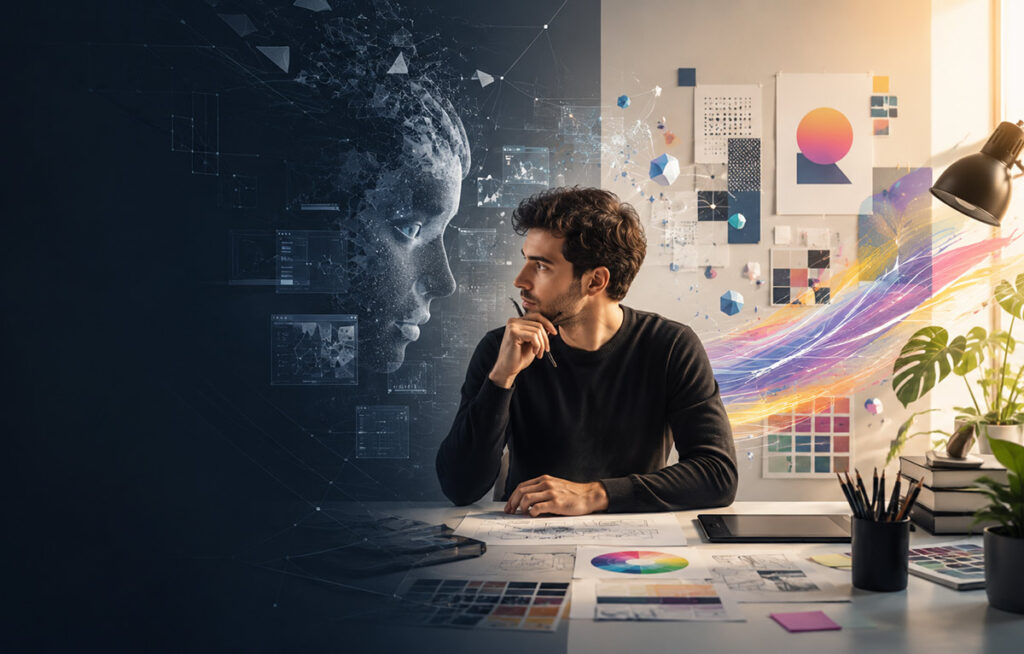
A new kind of fear has entered the creative world. It does not come from a blank canvas, a difficult client, or a last-minute deadline. It comes from a machine that can generate logos, posters, images, layouts, captions, mockups, and campaign ideas in seconds.
This fear is called AI phobia.
For many designers, artificial intelligence feels like a threat standing too close to their desk. It raises uncomfortable questions. Will AI replace designers? Will clients stop valuing human creativity? Will original ideas disappear under a flood of generated visuals? Will design become cheap, fast, and soulless?
These fears are real. But they are not the full story.
The truth is more interesting. AI phobia in design is not only creating anxiety; it is also creating growth. It is forcing designers to rethink their value, sharpen their skills, and understand what truly makes creative work powerful.
AI may be changing the tools, but it is also reminding designers that creativity is not only about making something look good. It is about making something mean something.
AI Can Generate, But Designers Give Direction
AI is fast. That is obvious. It can create ten visual ideas before a designer has even opened a file. But speed alone does not equal design intelligence.
A design is not successful because it exists. It is successful because it communicates the right message to the right audience in the right emotional tone.
That is where human designers still matter deeply.
AI can generate a poster, but it may not understand local culture. It can create a logo, but it may not understand brand history. It can suggest a layout, but it may not know whether the message feels respectful, bold, premium, friendly, political, emotional, or trustworthy.
A creative designer does not simply decorate. A designer decides.
AI creates output. Designers create meaning.
That difference is important. In a world where almost anyone can create a beautiful image with a prompt, the designer’s role becomes less about pushing buttons and more about making smart creative choices.
Fear Is Pushing Designers to Become Better Thinkers
Before AI became popular, many designers were judged mainly by execution. They were asked to make banners, remove backgrounds, resize posts, change colors, add text, and prepare files quickly. These tasks are still important, but they are no longer enough.
AI is pushing designers toward a higher level of value.
Today, a designer must think like a strategist. They must understand brand voice, audience behavior, campaign goals, visual hierarchy, emotional impact, and storytelling. They must know not only how to create a design, but why that design should exist.
This is where AI phobia can become useful.
Fear tells designers that the old comfort zone is no longer safe. It pushes them to learn, adapt, and grow beyond basic software skills. A designer who only knows tools may feel replaced by tools. But a designer who understands ideas, people, culture, and communication becomes more valuable than ever.
The future does not belong to designers who only know software. It belongs to designers who know strategy.
AI Is Making Originality More Important
One of the biggest problems with AI-generated design is sameness. Many AI visuals look polished, but they often feel familiar. The lighting is similar. The compositions are predictable. The colors follow trends. The style may look impressive at first glance, but after a while, everything begins to feel generic.
This is why originality matters more now.
Designers who have strong taste can instantly recognize when something looks beautiful but empty. They know when a design lacks personality. They know when typography feels weak, when spacing feels wrong, when the message is unclear, or when the visual tone does not match the brand.
AI can imitate what already exists. But great designers know how to add point of view.
They bring references from life, culture, cinema, politics, fashion, history, street signs, conversations, architecture, and human emotion. They do not only follow trends; they interpret them.
AI can copy style. A designer creates identity.
This is why AI phobia may actually help designers become more original. It reminds them that being average is dangerous. If AI can produce average work quickly, then the designer must become sharper, braver, and more distinctive.
AI Helps Designers Work Faster, Not Lazier
Some people think using AI means a designer is taking shortcuts. That is not always true. Used correctly, AI is not a shortcut for creativity; it is a shortcut through repetitive work.
Designers can use AI to brainstorm campaign ideas, explore visual directions, test headline options, create mood board concepts, generate rough layouts, rewrite copy, or prepare quick client presentation drafts.
This saves time. But saving time is not the same as removing creativity.
In fact, AI can give designers more room to think. Instead of spending hours stuck on the first draft, designers can explore more options faster. They can compare directions, reject weak ideas, refine stronger ones, and arrive at better creative solutions.
The key is control.
A weak designer may accept whatever AI produces. A strong designer questions it, edits it, improves it, and makes it brand-right.
AI should assist the designer, not become the designer.
The New Designer Is Also a Creative Director
AI is changing the designer’s role from maker to director.
In the past, a designer often started with a blank page. Today, they may start with prompts, references, AI-generated drafts, mood boards, and multiple visual options. But the final quality still depends on the designer’s eye.
A creative designer must now know how to guide AI properly. That means writing better prompts, choosing stronger references, explaining visual style clearly, and understanding what needs to be changed.
But more importantly, it means knowing what to reject.
Not every good-looking image is good design. Not every dramatic effect improves communication. Not every trendy layout is right for the client. The designer must protect the purpose of the work.
This is why creative direction is becoming one of the most valuable skills in the AI age.
The designer of the future is not just a creator. The designer of the future is a curator, editor, strategist, and visual leader.
AI Phobia Can Become AI Confidence
The best way to overcome AI phobia is not to ignore AI. It is to understand it.
Designers do not need to worship AI, and they do not need to fear it blindly. They need to practice with it. They need to test it, challenge it, and discover where it helps and where it fails.
Start by using AI for small tasks. Ask it for headline ideas. Use it to create layout inspiration. Generate color palette options. Explore campaign angles. Create first-draft captions. Then apply your own judgment.
The goal is not to let AI think for you. The goal is to use AI to expand your thinking.
A designer with weak fundamentals may become dependent on AI. But a designer with strong fundamentals becomes more powerful with AI.
Typography still matters. Composition still matters. Color theory still matters. Storytelling still matters. Brand understanding still matters. Human emotion still matters.
AI has not removed these skills. It has made them more necessary.
Why Human Creativity Still Wins
Human creativity comes from experience. It comes from memory, emotion, taste, failure, observation, humor, pain, culture, and instinct. These are not simple technical inputs.
A designer understands when a design needs silence instead of noise. They know when to make something bold and when to keep it minimal. They understand that a campaign poster must feel credible, that a luxury brand must feel refined, and that a community message must feel human.
AI can help build visuals, but it does not truly care about the people seeing them.
Designers do.
That care is part of the work. It is what makes design more than decoration. It is what turns a layout into a message and a message into movement.
The human designer brings intention. AI brings acceleration. Together, they can create stronger work.
Conclusion: AI Is Not the End of Design
AI phobia is understandable, but it should not become a creative prison. Fear often appears when the future is changing. But fear can also become a doorway.
For today’s creative designers, AI is not only a challenge. It is an invitation.
It invites designers to become better thinkers. It pushes them to build stronger taste. It encourages them to move beyond basic execution and step into strategy, storytelling, and creative direction.
The designers who grow in this new era will not be the ones who reject AI completely or depend on it blindly. They will be the ones who use it with purpose.
Because the future of design is not human versus machine.
The future of design is human imagination amplified by intelligent tools.